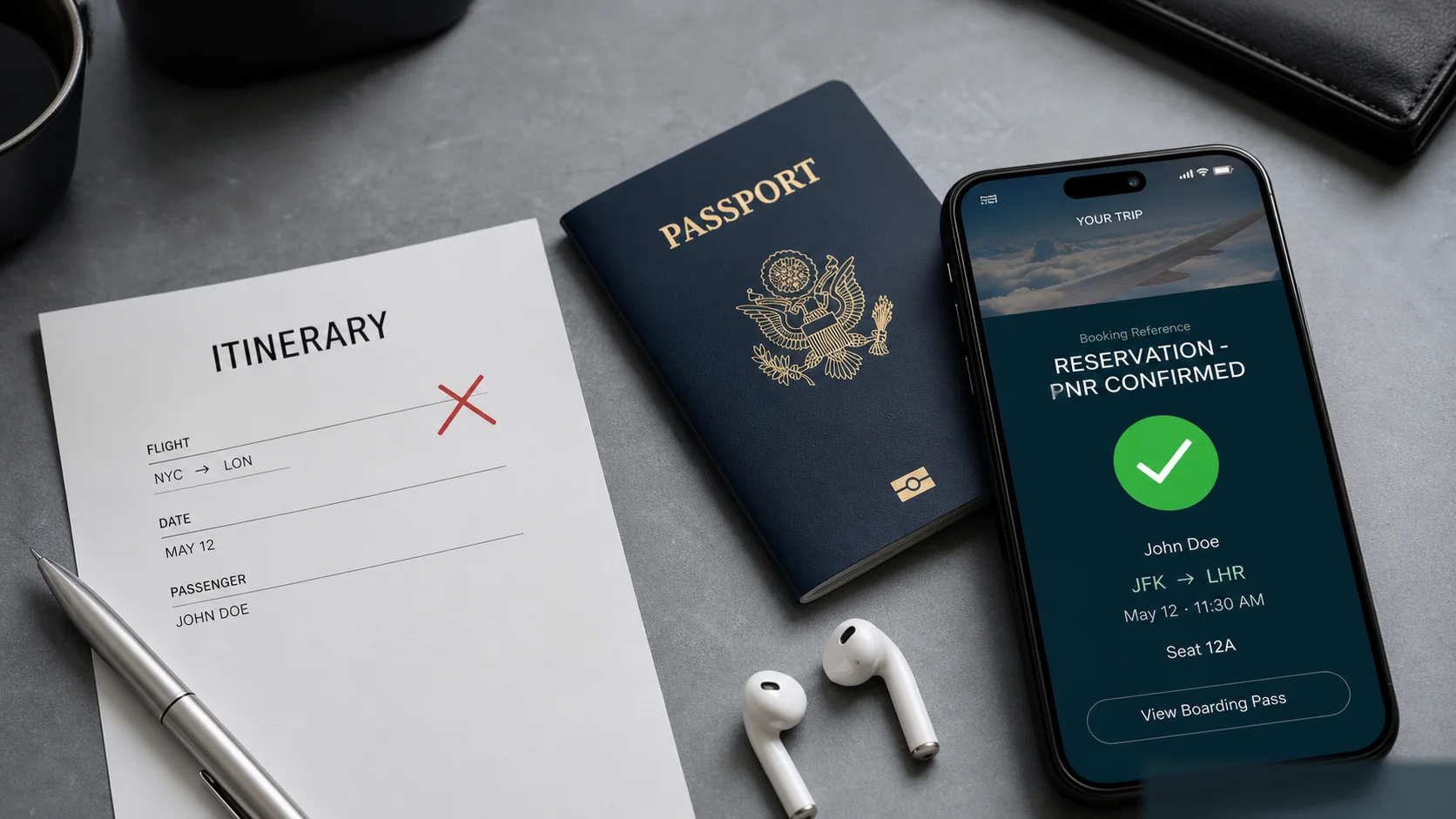
Flight Itinerary vs. Flight Reservation for Visas: What’s the Difference? (2026)
🔎 Featured Snippet Answer:
The main difference between a flight itinerary and a flight reservation is verification. A flight itinerary is simply a proposed schedule of travel detailing flights, dates, and times, but it is not necessarily booked. A flight reservation is a specific itinerary that has been officially placed on hold in an airline's database (GDS) by a travel agency, generating a live, verifiable PNR code that embassies accept for visa applications.
⚡ Quick Answer for Visa Applicants
The Confusion: Visa checklists use terms like "flight itinerary," "flight reservation," and "dummy ticket" interchangeably, causing massive anxiety for applicants.
Flight Itinerary: A schedule of your flights. Without a PNR code, it is just a piece of paper. Embassies will reject a plain itinerary.
Flight Reservation: A held seat on a real flight with a live PNR code. You haven't paid the full fare, but the airline recognizes the booking. Embassies require this.
Flight Ticket: A fully paid, confirmed flight. Embassies advise against buying this before your visa is approved.
The Solution: A legitimate "dummy ticket" is the exact same thing as a "flight reservation." It provides the required PNR without the financial risk of a full ticket.
If you are applying for an international visa in 2026, you have likely downloaded a document checklist from an embassy or a processing center like VFS Global.
As you read through the requirements, you will encounter travel terminology that seems designed to confuse you. One consulate asks for a "Flight Itinerary." Another demands a "Confirmed Flight Reservation." Another says, "Provide proof of travel arrangements." Meanwhile, every travel blog on the internet is telling you to buy a "Dummy Ticket."
Are these all the same thing? If you submit a typed-out itinerary, will your visa be rejected? If you don't buy a fully confirmed ticket, will the consular officer deny your application?
The terminology you use—and the documents you submit—can mean the difference between a passport stamped with a shiny new visa and a devastating rejection letter. The travel and immigration industries use specific jargon, and misunderstanding it is one of the leading causes of visa refusals worldwide.
This comprehensive guide will strip away the confusion. We will explore the exact technical differences between a flight itinerary and a flight reservation, explain what consular officers are actually looking for on their computer screens, and show you how to securely acquire the exact document you need without risking your life savings.
📝 What is a Flight Itinerary?
Let's begin with the most basic building block of travel documentation: the flight itinerary.
In the purest sense of the word, a flight itinerary is simply a proposed route or schedule of travel. It details the who, where, and when of a journey.
A standard flight itinerary includes:
Departure airport and arrival airport
Flight numbers (e.g., BA123)
Departure and arrival times
The name of the operating airline
Passenger names
The Fatal Flaw of a Simple Itinerary
Here is the critical distinction that causes thousands of visa rejections every year: An itinerary does not mean a booking exists.
You can open a Microsoft Word document right now, type out a realistic-looking schedule of flights from New York to London, print it out, and call it a "flight itinerary."
If you hand this self-made itinerary to a visa officer, your application will be instantly rejected. Why? Because a simple itinerary carries zero legal weight. It proves that you know how to look up flight schedules on Google Flights, but it provides absolutely no proof that you have taken any tangible steps to secure that journey.
When an embassy checklist asks for a "Flight Itinerary," they are using shorthand. What they actually mean is a Confirmed Flight Itinerary or a Flight Reservation.
🎫 What is a Flight Reservation?
A flight reservation takes the concept of an itinerary and injects it into the official global aviation system.
When you make a flight reservation, a licensed travel agency uses an enterprise portal (connected to a Global Distribution System like Amadeus or Sabre) to communicate directly with an airline. The agency tells the airline: "Hold a seat on this specific itinerary for this specific passenger."
The Magic of the PNR
The moment the airline accepts this hold, their database generates a Passenger Name Record (PNR). This is a unique 6-character alphanumeric code (e.g., X8T4MP).
This PNR is the dividing line between a useless piece of paper and a legally compliant visa document.
A Flight Itinerary = A proposed schedule.
A Flight Reservation = A proposed schedule + a live PNR code in the airline's database.
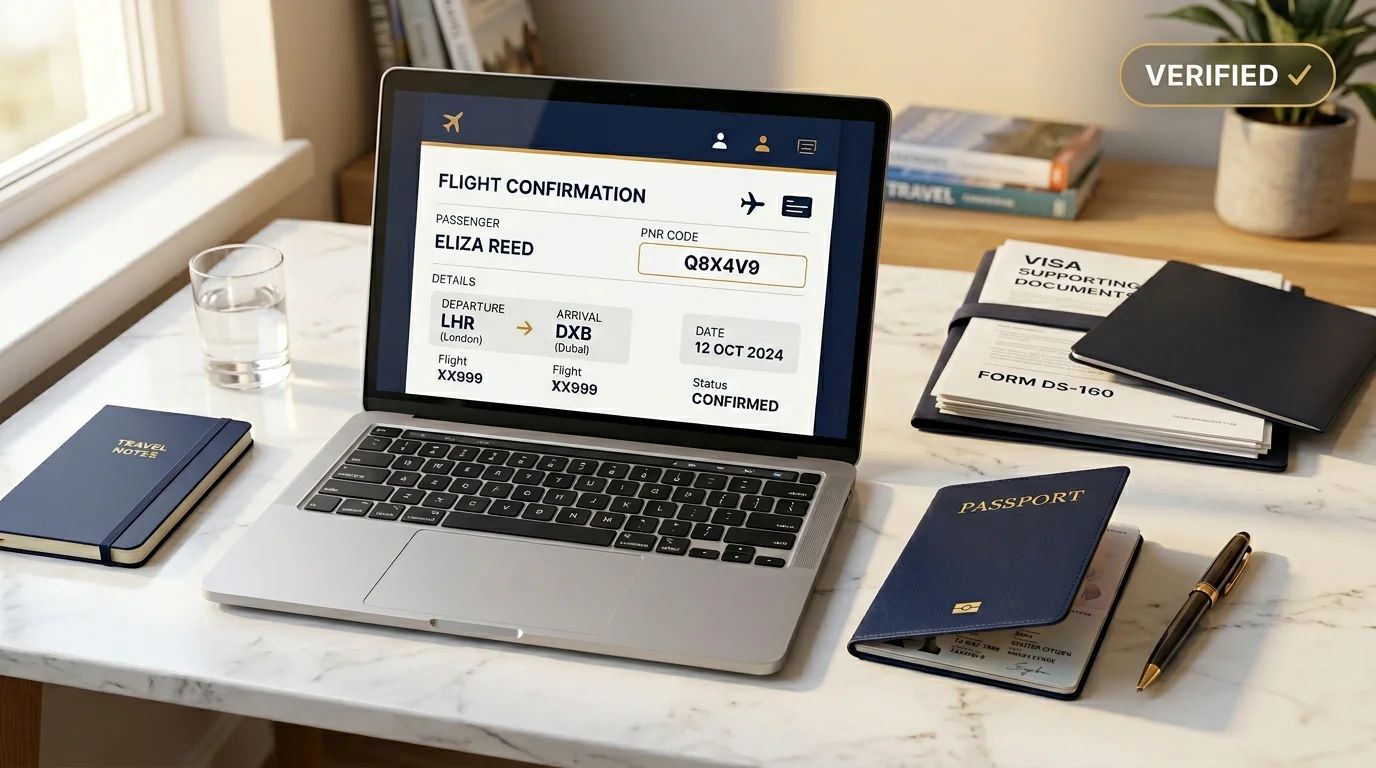
When you submit a flight reservation to an embassy, the consular officer looks at the PNR code on the document. They type that code into their computer system. Because it is a legitimate reservation, the airline's database responds and confirms that the seat is currently being held for you.
The embassy now has mathematical, verifiable proof of your travel intent.
🎟️ What is a Flight Ticket?
The final evolution of this process is the Flight Ticket (or e-Ticket).
A flight reservation becomes a flight ticket only when the full airfare is paid to the airline.
Once the travel agency (or you, via a credit card) transfers the money, the airline's financial department clears the payment and issues a unique 13-digit e-ticket number. At this point, the status of your PNR changes from "On Hold" to "Ticketed/Confirmed."
Why Embassies Warn Against Buying Tickets
It seems logical to assume that if an embassy wants proof of travel, a fully paid ticket is the best option. However, embassies actively discourage this.
The official guidelines for the Schengen Visa (and many others) explicitly state: "Applicants are advised not to purchase non-refundable tickets until their visa is approved."
Consular officers know that visas can be rejected for dozens of reasons—insufficient funds, lack of ties to the home country, or security concerns. They do not want to be held responsible for applicants losing thousands of dollars on non-refundable airfare.
This is why they prefer the Flight Reservation. It provides the verifiable PNR they need for security checks, without exposing the applicant to massive financial risk.
📊 Comparison Table: Itinerary vs. Reservation vs. Ticket
To make the distinctions crystal clear, here is a technical breakdown of the three terms and how embassies view them.
🤖 Where Does the "Dummy Ticket" Fit In?
If the industry terms are Itinerary, Reservation, and Ticket, why is the internet obsessed with the term Dummy Ticket?
"Dummy ticket" is simply colloquial slang created by the backpacking and digital nomad community.
When a traveler says "Dummy Ticket," they are referring to a Flight Reservation.
It is called a "dummy" ticket because it acts as a placeholder. It looks exactly like a real ticket, it contains a real PNR, and it verifies exactly like a real ticket, but it hasn't been fully paid for.
⚠️ Crucial Warning: Because "dummy ticket" is an unregulated slang term, it has been co-opted by scammers. Many websites sell "dummy tickets" for $2. These are not flight reservations. They are fake PDF itineraries with invented PNR codes. If you submit a fake $2 PDF, it functions like a simple itinerary: it fails the embassy's PNR check, resulting in a visa denial for document fraud.
When you buy a dummy ticket, you must ensure you are actually purchasing a verifiable flight reservation from a B2B travel agency.
🛂 What Do Embassies Actually Want?
Now that we have untangled the semantic confusion, we can look at what consular officers are actually doing when they process your application file at VFS Global or TLScontact.
The Schengen Visa Standard
European consulates (like Germany, France, and Spain) are incredibly strict. Their checklists will almost always ask for a "Round-trip flight itinerary."
Despite the use of the word "itinerary," what they are mandating is a Flight Reservation.
When the German consulate receives your application, they do not just glance at the paper. They input your PNR into their verification terminal. They expect to see a live hold on a flight. They also expect the dates on this reservation to perfectly match the dates on your Schengen Travel Insurance and your Dummy Hotel Booking.
The US Visa (B1/B2) Standard
The US tourist visa relies much more heavily on the face-to-face interview than on strict document checklists. The US Embassy explicitly states that you do not need to book flights before the interview.
However, bringing a verifiable Flight Reservation to your interview is a massive advantage. If the officer asks about your travel plans, handing them a printed reservation proves you are organized, logical, and have a distinct plan to return to your home country.
The Proof of Onward Travel Standard (Airport Check-in)
If you are a digital nomad flying one-way to Thailand or Colombia, the airline check-in agent will demand "proof of onward travel."
They will not accept a simple typed itinerary. They will demand a Flight Reservation or a Flight Ticket. They will type the PNR into the Advanced Passenger Information System (APIS). If the PNR is live, they print your boarding pass. If it fails, they deny you boarding.
✅ Step-by-Step: How to Get the Right Document (A Verifiable Reservation)
To ensure your visa application or airport check-in goes flawlessly, you must procure a legitimate Flight Reservation (a verifiable dummy ticket). Here is exactly how to do it safely.
Step 1: Ignore Free Generators
Never use a website offering a "free flight itinerary for visa." These sites generate fake PDFs without communicating with airline databases. They do not produce live PNRs and will result in visa refusals.
Step 2: Use a Registered B2B Platform
Navigate to a trusted service like buydummytickets.com. These platforms operate as licensed travel agencies, giving them access to Global Distribution Systems (GDS) to place legitimate holds on airline seats.
Step 3: Input Exact Passport Data
The consular officer will check your flight reservation against the MRZ (Machine Readable Zone) on your passport. Your name must be spelled perfectly.
Step 4: Time the Holding Period
Flight reservations expire. Because the full airfare hasn't been paid, airlines automatically release the held seats after a certain period (usually 48 hours to 14 days).
Order your reservation 24 to 48 hours before your physical VFS Global appointment or embassy interview. This ensures the PNR is fresh and active when the officer reviews it.
Step 5: Verify the Document Yourself
When you receive your flight reservation PDF, locate the 6-character PNR. Go directly to the official website of the airline (e.g., KLM, Emirates), click "Manage Booking," and enter the PNR and your surname. If your booking appears on the official airline site, you possess a legally compliant Flight Reservation.
⚠️ Common Mistakes Visa Applicants Make
Even when applicants understand the difference between an itinerary and a reservation, logistical errors can still ruin an application.
Mistake 1: Submitting a "Screenshot" Itinerary
Some applicants go to Expedia or Google Flights, select a flight, proceed to the checkout page, and take a screenshot of the itinerary before entering their credit card. They print this screenshot and submit it.
Why it fails: A screenshot does not generate a PNR. The embassy views this as a simple unverified itinerary and will reject the application. You must complete the hold process through a travel agency.
Mistake 2: Disconnected Travel Dates
If you secure a legitimate flight reservation arriving in Rome on September 1st, but your dummy hotel booking starts on September 3rd, the embassy will spot the gap. Your itinerary is considered "illogical," and your visa will be denied. All travel documents (flights, hotels, insurance) must synchronize perfectly.
Mistake 3: Re-using an Expired Reservation for an Appeal
If your visa is delayed or rejected, and you file an appeal three weeks later, your original flight reservation will have expired. You cannot submit the old document. You must generate a fresh, live flight reservation for the new submission date.
💡 Expert Tips for a Stronger Visa File
To maximize your chances of visa approval, frame your flight reservation professionally within your broader application dossier.
Mention it in the Cover Letter: Your cover letter is your opportunity to speak directly to the consular officer. Write: "Enclosed is my verifiable flight reservation. In accordance with embassy guidelines advising against purchasing non-refundable airfare prior to approval, I will finalize the ticketing of this itinerary immediately upon the issuance of my visa." This shows you understand and respect their rules.
Keep Class Realistic: Ensure your flight reservation matches your financial profile. If you are a student, provide an Economy Class reservation. A First Class reservation on a modest budget looks highly suspicious and triggers intense scrutiny.
Print Professionally: Submit your flight reservation printed on clean A4 paper. Ensure the PNR code and airline logo are highly visible. Professional presentation reduces subconscious friction during the review process.
📌 Important Considerations for Final Ticketing
It is essential to remember the ultimate purpose of a flight reservation: it is a temporary bridge to secure your visa.
Once your visa is approved and your passport is returned with the visa sticker, the purpose of the dummy ticket/reservation is complete. It will naturally expire.
You are now free to purchase your actual flight tickets. You are generally not legally obligated to take the exact same flight, on the exact same dates, on the exact same airline as the dummy ticket you submitted—provided you still travel within the validity dates of the visa granted to you.
Always check the specific restrictions on your issued visa sticker (e.g., duration of stay, valid from/to dates) before making your final, non-refundable flight purchases.
🌍 Conclusion: Clarity Brings Confidence
The bureaucratic language of international immigration is inherently confusing. When a checklist demands a "flight itinerary," it is easy to assume a simple piece of paper will suffice.
However, by understanding the underlying technology of the aviation industry—specifically the Global Distribution System and the Passenger Name Record (PNR)—you now know the critical difference. A simple itinerary is a proposed schedule. A Flight Reservation is a verifiable, held seat on a commercial airline.
Embassies and border agents require the mathematical certainty of a live PNR. By utilizing a legitimate travel agency to secure a verifiable flight reservation (a safe dummy ticket), you fulfill this strict requirement without exposing yourself to the massive financial risk of buying a non-refundable ticket.
Clear up the confusion, prepare your documents meticulously, and apply with confidence.
Ready to secure your embassy-compliant documentation? Get your verifiable flight reservation today and ensure your visa application is approved without a hitch.
Frequently Asked Questions (FAQ)
1. What is the difference between a flight itinerary and a flight reservation?
A flight itinerary is simply a proposed schedule of travel (dates, times, and destinations) and does not require a booking. A flight reservation is a specific itinerary that has been officially held in an airline's database by a travel agency, generating a live, verifiable PNR code.
2. Will an embassy accept a typed-out flight itinerary for a visa?
No. Embassies require verifiable proof of your travel plans. A typed itinerary or a screenshot from a booking website does not contain a live PNR code. Consular officers will reject these as they cannot be verified in the airline system.
3. Is a dummy ticket the same thing as a flight reservation?
Yes, in the travel industry, a legitimate "dummy ticket" is simply colloquial slang for a temporary flight reservation. As long as it is generated by a B2B travel agency and contains a live PNR, it functions exactly like a flight reservation.
4. Should I just buy a fully confirmed flight ticket instead?
Embassies actively advise against buying fully confirmed, non-refundable tickets before your visa is approved. Visas can be rejected for many reasons, and embassies do not want applicants losing thousands of dollars. A flight reservation is the safest, embassy-preferred method.
5. How do consular officers verify my flight reservation?
Consular officers verify your reservation by entering the 6-character PNR code and your surname into the airline's official website or their own Global Distribution System (GDS) terminal. If the reservation is real, it will show as "On Hold" or "Confirmed" in the system.
6. What happens if my flight reservation expires while my visa is processing?
Embassies are fully aware that unpaid flight reservations eventually expire. As long as the PNR was live and verifiable on the exact day the consular officer initially reviewed your application file, it is generally accepted without issue.
7. Can I use a flight reservation to board an airplane?
No. A flight reservation (dummy ticket) is an unpaid hold on a seat. You cannot use it to board the flight listed on the document. However, you can use it at check-in to show the airline agent proof of onward travel for a different flight.
8. What is a fake flight itinerary?
A fake flight itinerary is a document generated by a free website or a PDF editor that looks like a real ticket but contains an invented PNR code. Because it is not connected to an airline database, it will fail embassy verification and cause instant visa denial.
9. How much does it cost to get a verifiable flight reservation?
A legitimate, verifiable flight reservation typically costs between $10 and $20 USD. This small service fee covers the travel agency's operational costs and portal access fees required to securely hold the seat on the commercial flight.
10. How can I check if my flight reservation is legitimate?
You can verify it yourself before submitting it to the embassy. Take the PNR code from your document, go directly to the official website of the airline (e.g., Lufthansa, Air France), click "Manage Booking," and enter your details to view your live itinerary.


Leave a Comment
Your email address will not be published. Required fields are marked *