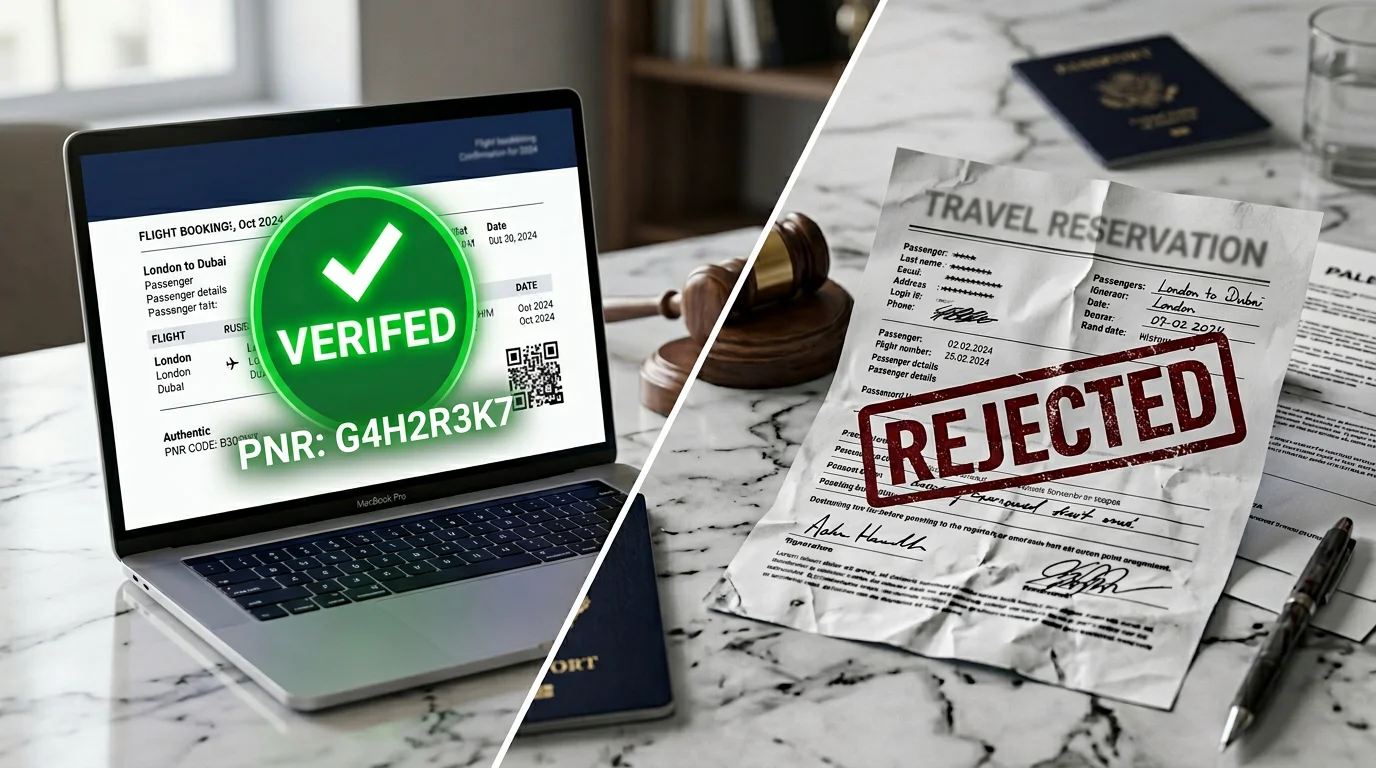
Is a Dummy Ticket Illegal? What Actually Happens When You Cross the Line
Here is the honest answer, without any softening: it depends entirely on what kind of dummy ticket you are using.
A genuine, GDS-generated flight reservation with a verifiable PNR — the kind produced by legitimate travel consultancies through Amadeus or Galileo — is not illegal. It is a real booking held in an airline's system, submitted as a flight reservation, which is precisely what every embassy checklist asks for.
But a fake dummy ticket — a PDF edited in Photoshop, a fabricated booking reference, a template-generated document with no real airline reservation behind it — sits squarely in the territory of document fraud. And document fraud, when it involves visa applications, carries consequences that travelers seriously underestimate.
This article is not about reassuring you that dummy tickets are fine. There are already articles covering that. This one is about the other side of the line: what illegal actually looks like in this context, what happens to people who cross it, and what specific legal frameworks treat it as a criminal matter — including in India, the UK, the Schengen zone, the UAE, and beyond.
If you want to understand the risk zone clearly, read this before booking anything.
The Legal Line: Drawn Simply
Before getting into consequences, let us establish the line as precisely as possible, because confusion about this is exactly what gets travelers into trouble.
A dummy ticket becomes illegal the moment it stops being what it claims to be.
A genuine flight reservation says: "There is a real booking in this airline's system under this passenger's name, on this route, for these dates." That statement is true. The booking exists. The PNR verifies. The document represents reality.
A fake ticket says the same thing — but the statement is false. There is no booking. The PNR does not exist, or it belongs to someone else's booking, or it has been copied from a real ticket and the name altered. The document misrepresents reality to a government authority.
That misrepresentation — knowingly presenting a false document to a government authority to obtain a benefit (a visa) — is the textbook definition of document fraud in most legal systems worldwide.
The technical name for the illegal version varies by country:
- In India: Forgery of a valuable security or document under the Bharatiya Nyaya Sanhita, 2023 (sections 336–340)
- In the UK: Fraud by false representation under the Fraud Act 2006 (section 2)
- In the Schengen zone: Visa fraud / document falsification under each member state's criminal code
- In the UAE: Document forgery under Federal Decree-Law No. 34 of 2021
None of these are minor infractions.
What "Illegal" Actually Looks Like — The Four Types of Fake Tickets
Not all travelers who use fake dummy tickets know they are doing something illegal. Some buy from providers who never mention that the document has no real PNR. Understanding exactly what crosses the line helps you recognize the risk before it is too late.
Type 1: The Edited PDF
Someone takes a real airline booking confirmation — perhaps from their own previous travel, perhaps a screenshot found online — and alters the passenger name, travel dates, or route using image editing software. The airline branding, format, and layout look authentic. But the underlying booking reference either does not exist or belongs to a completely different person on a completely different route.
This is the most common form of fake dummy ticket. It is also the easiest for embassy officers and immigration staff to detect, because the PNR either fails verification or returns the wrong name.
Type 2: The Free Generator Output
Several websites offer "free dummy ticket generators" — tools where you type in a passenger name, select a route, choose dates, and download a professional-looking PDF. The document looks identical to a real booking confirmation. It even shows a six-character code in the PNR field.
But that code is fabricated. It was never entered into any airline's reservation system. When an embassy officer opens the airline's "Manage Booking" page and types in that code, one of two things happens: the system says the booking does not exist, or it returns an error. Either outcome flags the application immediately.
Type 3: The Expired or Cancelled Real Ticket
Some travelers obtain a genuine dummy ticket through a legitimate provider — but then reuse the PDF months later, after the hold period has expired and the reservation has cancelled. The PNR still appears on the document. But when checked, it either shows "cancelled" or no longer appears in the airline's system at all.
Submitting a document whose status no longer matches what the paper says is misrepresentation, even if the booking was genuine at the time of generation. Always verify your PNR is still active immediately before submission.
Type 4: The Bought Fake From an Unreliable Service
Some services operating in informal channels — WhatsApp groups, Telegram, social media ads — offer "confirmed dummy tickets" at suspiciously low prices, sometimes for ?50–?150. These providers generate documents using templates or stock image editing, with no GDS connection. The PNR shown is either invented or recycled from publicly visible booking codes.
Travelers who buy from these sources often do not know the document is fraudulent until the embassy flags it. By then, the damage is already done.
What Actually Happens When a Fake Ticket Is Caught
The consequences of submitting a fake flight document to a visa authority are not hypothetical. They happen, and they follow a consistent pattern.
Immediate Visa Rejection
The most immediate consequence is that the application is rejected outright. This is not a routine rejection that can be reapplied for immediately — it is a rejection citing document fraud or misrepresentation, which creates a permanent note in your application history.
The note matters. Every future visa application you submit to that country — and often to partner countries — will flag your prior history. Officers who see a prior rejection for document fraud approach subsequent applications with significantly heightened scrutiny.
Visa Blacklisting
Several countries maintain formal or informal blacklists of applicants who have submitted fraudulent documents. Being placed on such a list does not mean a lifetime ban in every case — the duration varies — but it can mean:
- A 5–10 year ban from applying to Schengen countries in some documented cases
- Refusal of entry to the UK under the Standard Visitor category
- Flagging in the US visa system that follows all future B1/B2, F1, and immigrant applications
- A UAE entry ban, which can affect transit through major Gulf hubs
For Indian applicants specifically, a Schengen or UK ban creates a cascading effect: it makes future applications to any country that asks "have you previously been refused a visa?" significantly harder to manage.
Immigration Record Consequences
Beyond individual country bans, fraudulent document submissions can be flagged in shared immigration databases. Schengen member states share information through the Schengen Information System (SIS). UK Border Force maintains its own records. US Customs and Border Protection records visa fraud concerns, which can affect even legitimate future applications.
Once a fraud flag exists in these systems, it does not disappear automatically. Some records persist for years. Others become permanent markers that require substantial documentation to address through future applications.
Criminal Proceedings — Where It Can Go Further
In most cases, an individual traveler caught with a fake flight document faces administrative consequences: rejection, ban, and a note on record. Criminal prosecution of individual applicants is less common — but it is not impossible, particularly in the following situations:
In India (Bharatiya Nyaya Sanhita, 2023): Section 336 of the BNS covers forgery of documents used to commit fraud. Section 338 covers the use of a forged document as genuine. An applicant who purchases and presents a fabricated airline ticket to a foreign embassy could, in principle, face charges under these provisions if the matter is referred to Indian authorities. The maximum penalty under BNS forgery provisions ranges from 2 to 7 years of imprisonment, plus fines.
In practice, prosecution of individual visa applicants under these sections is uncommon. However, the operators of services that manufacture and sell fake tickets face real criminal exposure under both BNS provisions and the Information Technology Act, 2000.
In the United Kingdom (Fraud Act 2006): Presenting a false document to obtain a visa benefit constitutes fraud by false representation under Section 2 of the Fraud Act 2006. This carries a maximum sentence of 10 years' imprisonment in Crown Court proceedings. UK Visas and Immigration can and does refer suspected document fraud cases to police for investigation in serious cases.
In Schengen Countries: Each Schengen member state has its own criminal code governing document fraud. Germany's Urkundenfälschung (Section 267 StGB) carries up to 5 years' imprisonment. France's faux et usage de faux (Article 441-1 Code Pénal) carries up to 3 years and a €45,000 fine. These provisions apply to any document fraud detected in connection with a visa application, regardless of where the document was created.
In the UAE: Federal Decree-Law No. 34 of 2021 on document forgery provides for imprisonment of up to 5 years and fines of up to AED 200,000 for forging or using forged official documents. UAE courts have applied these provisions to travel document fraud cases.
How Embassies Actually Detect a Fake Ticket
This question comes up constantly in traveler forums, and the answer is more thorough than most people realize.
Live PNR Verification
The primary check is straightforward: the embassy officer opens the airline's official website or calls the airline's reservation line, enters the PNR, and checks whether it exists and matches the document. This takes under two minutes. A fabricated or recycled PNR fails this check immediately.
Cross-Document Date Consistency Checks
Even if a PNR verifies, officers compare the flight dates against:
- The hotel booking confirmation
- The travel insurance policy dates
- The application form's stated visit dates
- Previous trips in your passport
A document that verifies but whose dates are inconsistent with the rest of the application raises questions that often lead to deeper scrutiny.
Formatting and Authenticity Checks
Experienced visa officers process thousands of airline booking confirmations. They know what legitimate documents from Lufthansa, Emirates, Air India, Qatar Airways, and others look like — the font, the layout, the booking reference format, the footer content. Documents produced by free generators or amateur editing often have subtle formatting inconsistencies that are immediately visible to trained eyes.
Database Cross-Referencing
In some high-volume embassies, document verification software is used that cross-references submitted PNRs against airline databases directly. This is increasingly common at Schengen embassies processing high volumes of applications from countries with documented fraud rates.
The Risk Most People Ignore: The Provider, Not Just the Document
Here is something that rarely gets discussed: even if you did not know the ticket was fake, using a document from an unverified provider creates legal exposure for you.
In most legal frameworks, the intent element of document fraud requires that you knew or ought to have known that the document was false. "I bought it online and didn't know" is a defence — but it is a weak one when:
- The price was suspiciously low (?50–?200 for a "verified dummy ticket")
- The provider had no verifiable business identity
- There was no receipt, no company name, no official communication
- You did not check the PNR before submitting
The safest position is always one where you can demonstrate that you:
- Used a legitimate, identifiable provider with a real website and payment record
- Received a proper invoice or confirmation
- Verified the PNR yourself on the airline's official website before submission
- Submitted the document honestly as a flight reservation — which is what it was
That trail of evidence is what separates "I made a reasonable purchase in good faith" from "I knowingly used a fraudulent document."
The Correct Version: What a Legal Dummy Ticket Looks Like
To make the contrast clear, here is what distinguishes a legitimate, legal dummy ticket from the fake versions described above.
A legal dummy ticket issued by a reliable provider:
- Is generated through an official Global Distribution System — Amadeus or Galileo — by a registered travel consultancy
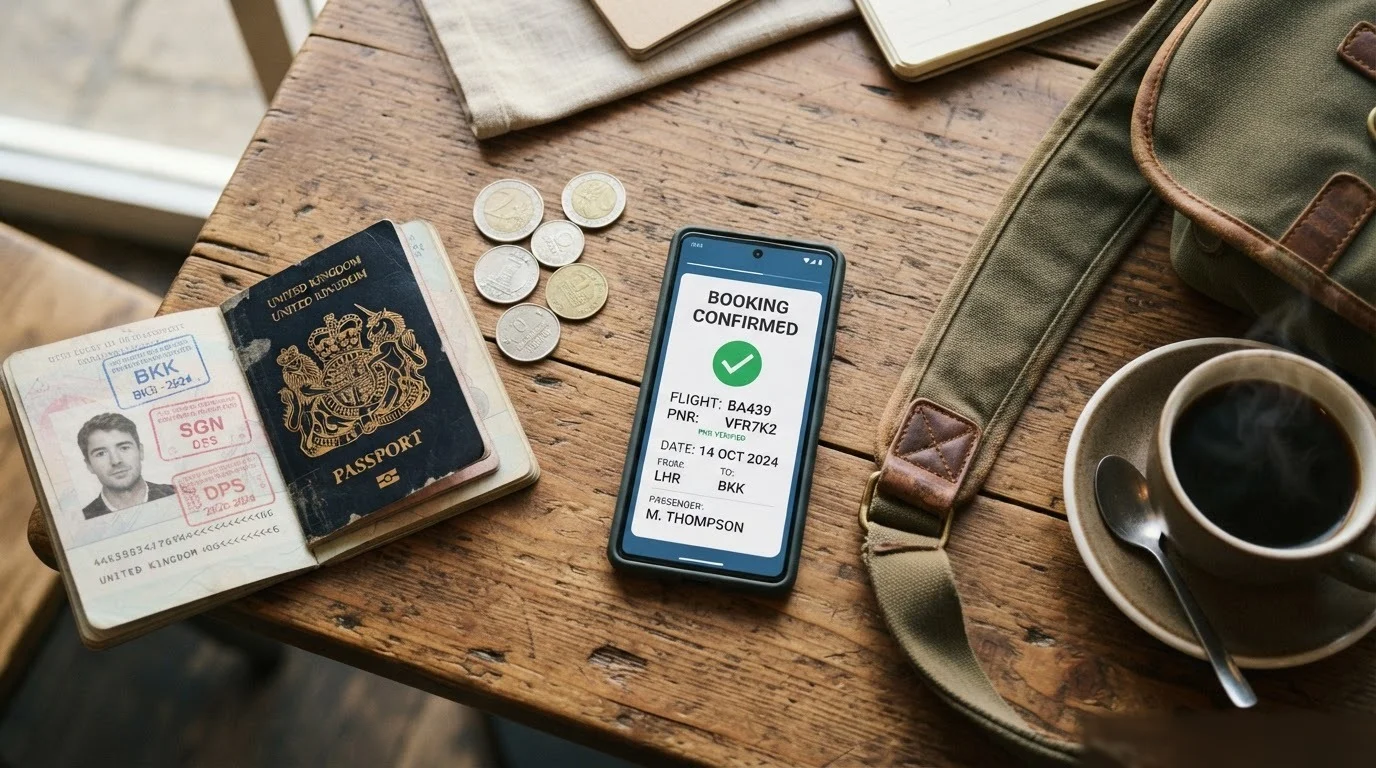
- Carries a real, live PNR that immediately verifies on the airline's "Manage Booking" page
- Shows the passenger's correct legal name, exactly as in their passport
- Has a realistic, operating flight route with a real flight number
- Carries a validity period of 2–3 weeks — the standard hold period — before auto-expiring
- Is delivered as a professional PDF identical in format to any legitimate booking confirmation
- Is submitted to an embassy as a flight reservation — which is both what it is and what the embassy is asking for
When you submit this document to a Schengen embassy, UK Visas and Immigration, the US consulate, or any other visa authority — the officer can verify it, it passes every check, and it satisfies the documentation requirement exactly. There is nothing illegal about it because there is nothing false about it.
At BuyDummyTickets.com, every reservation is generated through Amadeus or Galileo by a licensed travel consultancy. The PNR is live from the moment of delivery. You can verify it yourself within minutes of receiving the PDF — and you should, before submitting anything to an embassy.
Tickets are delivered within 15 minutes via email and WhatsApp. The flight plus hotel combo at ?600 covers both documentation requirements for Schengen, UK, and most other visa applications in a single order.
Country-Specific Summary: Where Consequences Are Most Severe
| Country / Region | Risk If Caught with Fake Ticket | Criminal Exposure? |
|---|---|---|
| Schengen Zone (26 countries) | Visa rejection + 5–10 year ban + SIS flagging | Yes — varies by member state, up to 5 years |
| United Kingdom | Visa rejection + entry ban + police referral possible | Yes — Fraud Act 2006, up to 10 years |
| United States | Visa denial + potential bar to future immigrant/non-immigrant visas | Case-dependent; misrepresentation bar under INA §212(a)(6)(C) |
| UAE | Entry ban + potential deportation | Yes — Federal Decree-Law No. 34, up to 5 years + AED 200,000 fine |
| India (applicant prosecuted abroad) | Foreign ban reflected in future applications | BNS sections 336–340 for domestic operators |
| Philippines | Immigration detention, deportation | Aviation security regulations |
| Thailand / Bali | Denied entry, detained at immigration | Immigration Act provisions |
Frequently Asked Questions
Is a dummy ticket illegal?
A dummy ticket is not illegal when it is a genuine GDS-generated flight reservation with a verifiable PNR. It becomes illegal when it is a fabricated or altered document — a fake ticket presented to deceive a government authority. The distinction is absolute: a real reservation is legal; a forged document is fraud.
What is the punishment for using a fake flight ticket for a visa?
Consequences range from visa rejection and long-term blacklisting to criminal prosecution depending on the country. In the UK, fraud by false representation under the Fraud Act 2006 carries up to 10 years in prison. Schengen states apply their own criminal codes, with sentences of 2–5 years. In the UAE, document forgery penalties include up to 5 years imprisonment and fines of up to AED 200,000.
Can an embassy detect a fake dummy ticket?
Yes. The primary detection method is live PNR verification on the airline's official website — a process that takes under two minutes. Officers also check date consistency across all submitted documents and assess formatting authenticity. Experienced visa officers process thousands of booking confirmations and recognize inconsistencies immediately.
What happens if I unknowingly submitted a fake ticket?
"I did not know" is a potential defence but a weak one if the purchase circumstances were suspicious (very low price, no receipt, unidentifiable provider). Your strongest position is to always verify the PNR yourself before submitting, keep a payment record from the provider, and submit the document honestly as a reservation — not a confirmed ticket.
Is a free dummy ticket generator legal to use?
No. Free generators produce documents with fabricated PNRs — there is no real reservation in any airline system. These documents cannot be verified and constitute misrepresentation when submitted to a visa authority. Do not use them.
Does using a dummy ticket get you blacklisted?
Using a legitimate dummy ticket (real GDS reservation, verifiable PNR) does not get you blacklisted. Using a fake ticket that fails embassy verification can result in blacklisting that affects future visa applications to that country and sometimes partner countries.
Is it illegal to use a dummy ticket in India?
Booking a genuine GDS reservation through a licensed travel consultancy is not illegal in India. What is illegal — under the Bharatiya Nyaya Sanhita, 2023 — is creating, selling, or using forged documents. Services that manufacture fake tickets (with fabricated PNRs) face criminal exposure. Individual travelers who knowingly present false documents to foreign embassies may also face legal consequences.
Which countries are strictest about fake flight tickets for visas?
The UK, Schengen member states (especially Germany and France), the UAE, and the United States take document fraud in visa applications the most seriously. All have formal legal provisions covering it, and all have documented cases of enforcement resulting in multi-year bans.
Conclusion
The question "is a dummy ticket illegal?" does not have one answer — it has two, depending entirely on which kind of dummy ticket you mean.
A genuine, GDS-generated flight reservation with a live, verifiable PNR is not illegal. It is the correct document for visa applications. Every major embassy asks for a reservation, not a confirmed purchased ticket. That is what a real dummy ticket provides.
A fabricated or altered flight document — one that cannot be verified, or that misrepresents a cancelled booking as an active one — is document fraud. The consequences are real: visa rejection, long-term blacklisting, immigration record flags, and in serious cases, criminal prosecution under the laws of the applying country or the receiving country.
The risk is not abstract. It is specific, documented, and growing as embassy verification systems become more thorough and automated.
The easiest way to stay completely on the right side of this line: use a provider whose reservations you can verify yourself, on the airline's own website, the moment you receive the document. If the PNR appears on the airline's Manage Booking page with your name and route — you are safe. If it does not — you are not.
Get a fully verifiable dummy ticket in 15 minutes, starting at ?475. Every booking is GDS-generated, embassy-ready, and verifiable on 500+ airlines.
? Book your dummy ticket at BuyDummyTickets.com ? Read our full FAQ before your visa appointment ? Generate your free visa cover letter
Last updated: June 2026 | Legal references verified against Bharatiya Nyaya Sanhita 2023, UK Fraud Act 2006, UAE Federal Decree-Law No. 34/2021, and Schengen Visa Code.
Internal Linking Opportunities
External Authority References (Suggested)
- UK Fraud Act 2006 (Section 2) — legislation.gov.uk — Reference when discussing UK legal consequences
- Schengen Visa Code (Regulation EC No 810/2009) — eur-lex.europa.eu — Reference for Schengen documentation requirements
- Bharatiya Nyaya Sanhita 2023 — indiacode.nic.in — Reference for Indian forgery provisions (Sections 336–340)
- UAE Federal Decree-Law No. 34 of 2021 — Reference for UAE document forgery penalties
- IATA Global Distribution System Overview — iata.org — Reference for GDS legitimacy
- Schengen Information System (SIS) — home-affairs.ec.europa.eu — Reference for shared Schengen blacklisting database


Leave a Comment
Your email address will not be published. Required fields are marked *