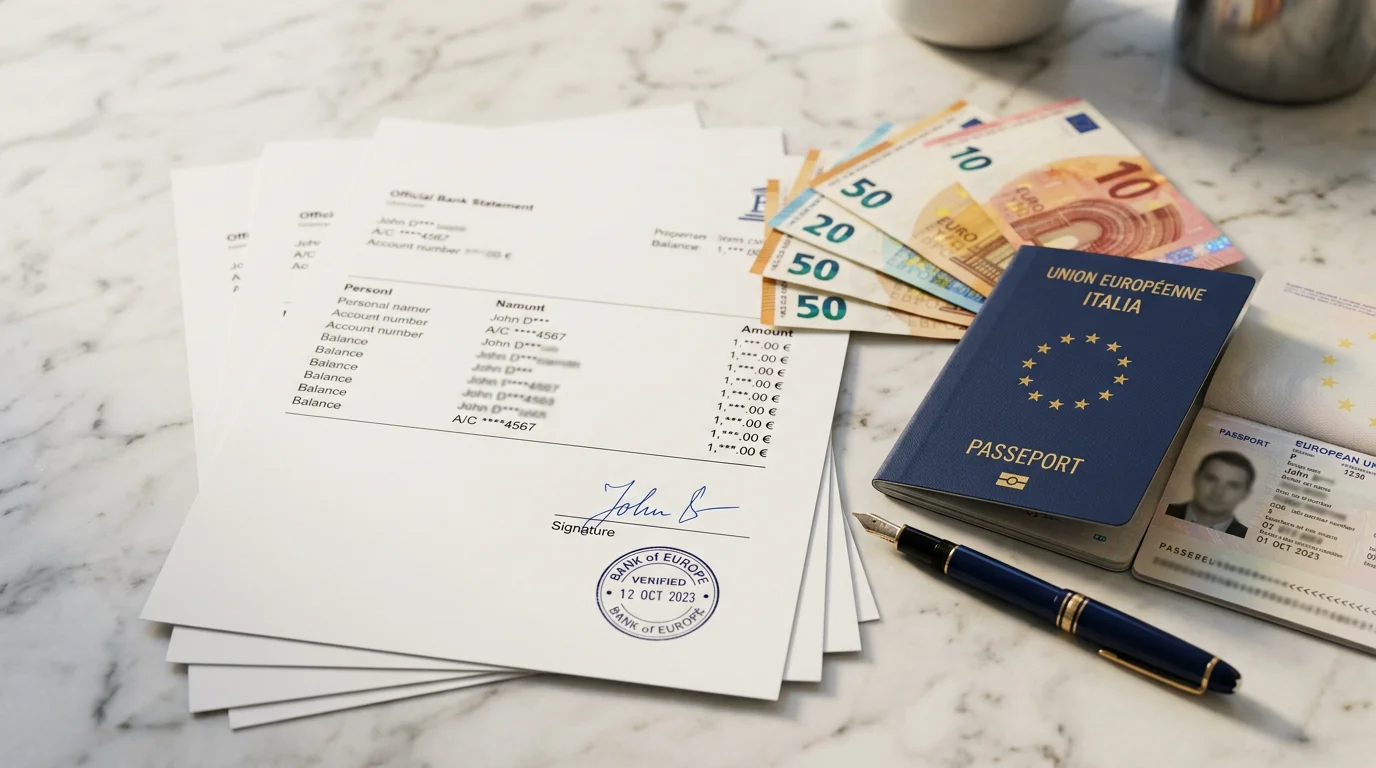
Bank Statement for Schengen Visa: Exactly How Much You Need and What Kills Your Application
The bank statement question causes more confusion — and more rejections — than almost any other part of a Schengen visa application.
One website says show ?50,000. Another says ?3 lakh. Someone on a forum says their cousin got approved with only ?80,000 but their application was rejected with ?2 lakh. And then there is the question that quietly panics almost every applicant: "I transferred money into my account last week to top it up — is that going to look suspicious?"
The confusion is understandable, because Schengen countries genuinely do not publish a single fixed minimum. Instead, they assess what EU law calls "means of subsistence" — your capacity to fund yourself for the duration of your stay without becoming a burden on the host country's public systems.
This guide cuts through all of it. You will find the exact country-wise daily requirements, the six bank statement mistakes that most commonly cause rejections (including the one about sudden deposits), what format your statement must be in, how many months you need, and how pre-booking your flights and hotel can actually reduce the balance you need to show.
Why Schengen Embassies Check Your Bank Statement
Your bank statement serves a specific purpose in a Schengen visa assessment — and it is not the purpose most applicants assume.
Officers reviewing your file are not checking whether you are rich. They are checking three things:
1. Can you fund this specific trip? Your balance needs to be enough to cover your daily expenses for the duration of your stay — food, local transport, activities, and any unexpected costs. Pre-booked accommodation and flights are credited against this calculation: if you have already paid for your hotel and return ticket, you need to show less in the bank, because those large costs are already settled.
2. Is your money genuinely yours and consistently available? A bank balance that appeared three days before your visa appointment, after months of near-zero activity, raises an immediate red flag. Officers are trained to spot borrowed funds, and a statement that shows a sudden large deposit without context is treated with serious skepticism.
3. Do your financial documents tell a consistent story? Your bank statement, salary slips, employment letter, and ITR (Income Tax Return) all describe the same reality: your financial life. If your salary slips say ?80,000 per month but your bank never shows salary credits anywhere near that amount, the inconsistency raises questions about the authenticity of all your documents.
Understanding this framework changes how you prepare your financial proof. You are not trying to hit an arbitrary number — you are building a coherent, credible financial picture.
How Much Bank Balance Do You Actually Need for a Schengen Visa?
There is no single universal number. Schengen countries each set their own daily "means of subsistence" rates. The amounts below represent practical expectations observed across consulates — not official published minimums, which vary by circumstance.
Daily Amount Requirements by Country
What This Means in Practice for Indian Applicants
For a 10-day trip to France (daily rate €100): You need to show €1,000 (~?90,000) just for daily expenses. Add a safety buffer of 1.5x: ?1,35,000 minimum closing balance on top of any pre-booked costs.
For a 14-day trip to Greece (daily rate €55): You need to show €770 (~?70,000) for daily expenses. With pre-booked hotel and return flight already paid, this drops significantly.
The pre-booking effect is significant: Pre-paid bookings significantly reduce the required balance, since accommodation is already settled. France and Germany apply the highest thresholds; Greece and Spain are more modest. This is the single most practical thing you can do to strengthen your financial profile: book your flights and hotel before submitting your application.
Recommended Closing Balance by Trip Length
These figures assume pre-booked accommodation and return flights, and a country with a mid-range daily requirement (€75–€90/day):
Always show 1.5x to 2x the calculated minimum. A statement that just barely clears the threshold invites scrutiny. A comfortable cushion signals genuine financial stability.
How Many Months of Bank Statements Do You Need?
The standard is 3 to 6 months, and the specific requirement varies by consulate:
- France, Germany, Netherlands: 6 months strongly preferred; 3 months minimum
- Spain, Italy, Greece, Portugal: 3 to 6 months accepted; 3 months typically sufficient
- Most other Schengen countries: 3 months minimum; 6 months recommended for first-time applicants
The practical rule: Submit 6 months if you have them and the account shows a consistently healthy balance. Submit 3 months if you are a first-time traveler with a relatively new account, but make sure those 3 months show clean, regular income and no suspicious transactions.
First-time travelers without prior visa stamps should default to 6 months of statements — the additional history helps compensate for the absence of a travel track record.
What Format Does Your Bank Statement Need to Be In?
This is where many applications fail — not because of insufficient balance, but because the statement format is wrong.
Accepted Formats ?
- Bank-stamped paper statements: Walk into your bank branch and request an account statement for the required period. The bank prints it on official paper and stamps and signs each page (or the last page). This is the most universally accepted format.
- Official net banking PDF: Many banks offer an authenticated PDF statement generated directly from the bank's portal (not a self-downloaded screen capture). These are accepted by most consulates but check whether your specific bank's PDF carries an authenticity watermark or verification link.
- Bank certification letter: Some applicants submit a bank balance certificate alongside their statement. This is supporting proof — not a substitute for the full transaction statement.
Not Accepted ?
- Screenshots from mobile banking apps: These are not verifiable, cannot be stamped, and are consistently rejected at virtually all Schengen consulates.
- Handwritten or self-printed statements: Any document that appears to have been created or edited by the applicant is grounds for immediate rejection and potential visa ban.
- Statement without account holder's name clearly printed
- Statement pages that are not stamped: If your bank provides multi-page statements, every page — or at minimum the signature page — should carry the bank's official stamp.
- Balance certificate alone: A certificate showing your current balance without transaction history is insufficient. Officers need to see the transaction pattern, not just the number.
The 6 Bank Statement Mistakes That Kill Schengen Applications
Mistake #1: Sudden Large Deposit Immediately Before Applying
This is the most common red flag in Indian Schengen applications. If your account shows large, sudden deposits just before applying, it may raise concerns about the legitimacy of your funds. To avoid this, maintain a steady balance that is consistently above the required amount for at least three months before applying.
Why it happens: An applicant realizes their balance is too low two weeks before submission and transfers a lump sum — from a savings account, a fixed deposit, or family members — to meet the threshold.
Why it fails: Officers are trained to spot this pattern. An account that sits at ?30,000 for five months and suddenly shows ?2.5 lakh before an application date is not a credible financial profile. It says "borrowed money to show," not "genuine savings."
What to do instead: If you must transfer funds from an FD breakup, an investment, or a family member, explain it in your cover letter and provide documentation — FD receipt, investment statement, or a family sponsorship letter with their own bank statements. Never leave large deposits unexplained.
Mistake #2: Submitting Only a Balance Certificate (Not a Full Statement)
Many Indian banks offer a "balance certificate" — a letter confirming the current account balance. Applicants sometimes submit this in place of a bank statement, assuming the number is all that matters.
It is not. Consulates handling thousands of Indian applications know exactly what manipulated documents look like. Only submitting a balance certificate is insufficient — full transaction statements are needed, not just a snapshot of current funds.
Officers need to see the transaction history — regular income credits, consistent spending patterns, and a balance that has been maintained over time. A certificate showing today's number without any history provides none of this.
Mistake #3: Using a Self-Printed or Unverified Online Statement
Downloading a statement from your bank's app and printing it at home — without official bank certification or stamping — is treated with strong skepticism at most Schengen consulates.
The correct process: Either request an official stamped paper statement from your bank branch, or confirm with your bank that their net banking PDF statements carry an authentication watermark or verification code that can be validated. Some banks (SBI, HDFC, ICICI) produce digitally certified PDFs; others do not.
If in doubt, spend the time and the ?100–?200 fee for a branch-stamped statement. For a document this important, it is not worth the risk of rejection on format grounds.
Mistake #4: Income Inconsistency Across Documents
Your bank statement says one thing. Your salary slip says another. Your employment letter says something slightly different. This three-way inconsistency is caught by officers who cross-check all three documents simultaneously.
Common inconsistency patterns:
- Salary slip shows ?80,000/month, but the bank shows no regular credit anywhere near that amount
- Employment letter states a senior position, but salary credits are entry-level
- Self-employed applicant shows good bank balance but no ITR submitted
- Freelancer shows client invoices totaling ?3 lakh/month but bank debits show a lifestyle inconsistent with that income
The fix: Before submitting, read your own financial documents together as if you are the officer. Do they tell the same story? If any number or pattern seems contradictory, either add an explanatory cover letter note or request corrected documents.
Mistake #5: Account Balance Drops to Near-Zero Regularly
An account that has a high closing balance but shows frequent near-zero dips throughout the statement period signals financial instability — even if the average looks acceptable.
Balance drops to near-zero regularly shows no financial cushion. No regular income credits: if your account only has one lump sum transfer and nothing looks like a salary, explain it.
Officers are looking for a pattern of consistent, stable financial behavior. An account that swings between ?20,000 and ?2.5 lakh unpredictably does not project the financial stability of someone who can comfortably fund a European trip.
Mistake #6: Not Explaining Unusual Transactions
Large transactions — whether deposits, withdrawals, or transfers — that appear without context in your statement will attract scrutiny. Property sale proceeds, a bonus from your employer, an inheritance, an FD maturity payout, or a family transfer — all of these can look suspicious without context.
Large, sudden deposits raise red flags. If legitimate, provide proof: a work bonus letter from your employer confirming the payment, a gift deed or letter from donor plus their bank proof, or tax refund documents. Always explain unusual transactions in your cover letter.
Can You Use a Sponsor's Bank Statement?
Yes — and this is a legitimate option for applicants whose own balance is insufficient.
When a sponsor is acceptable:
- A parent funding their child's trip (very common for student applicants)
- A spouse traveling together, with joint or combined financial proof
- An employer sponsoring a business trip
- A host in the Schengen country covering accommodation costs
What sponsorship documentation requires:
- A signed sponsorship/affidavit letter from the sponsor stating they are covering your trip expenses
- Relationship proof — birth certificate (parent-child), marriage certificate (spouses)
- The sponsor's bank statements (last 3–6 months), stamped and official
- The sponsor's proof of income (salary slips, ITR, or employer letter)
Important: A sponsorship letter alone is not sufficient. The officer needs to see that the sponsor has the funds — not just that they have agreed to provide them.
Does Pre-Booking Flights and Hotel Actually Reduce Your Required Balance?
Yes, and this is one of the most practically useful things you can do before applying.
The logic is simple: Schengen daily rates are designed to cover accommodation, food, and daily transport. If your accommodation is already paid for, the officer knows that a significant daily cost is already settled. The required "means of subsistence" assessment drops accordingly.
Example: A 10-day trip to Germany. Daily rate: €100. Total required: €1,000.
- Without pre-booking: Officer assesses full €1,000 requirement for daily expenses
- With hotel pre-booked: Accommodation portion (~€50–60/day) is already paid. Effective daily requirement may drop to €40–50/day for food and transport.
- With both hotel and return flight booked: Both major costs are settled. Required daily balance is at the lower end of the range.
This means a pre-booked dummy flight ticket and hotel reservation from BuyDummyTickets.com does not just satisfy your document checklist — it can meaningfully reduce the bank balance you need to demonstrate, making your overall application stronger.
The Flight + Hotel Combo at BuyDummyTickets.com costs $7 for both documents, delivered within 15 minutes. Combined with a $5 insurance certificate, you cover three document requirements that directly impact how your financial proof is assessed — for $12 total.
How to Strengthen a Weak Bank Statement
If your current balance is below what you would ideally show, there are several legitimate ways to strengthen your financial proof:
1. Submit multiple account statements If you have a savings account, a current account, and an FD — submit all three. The combined financial picture is what matters, not any single account in isolation.
2. Include your FD certificate A fixed deposit is a strong signal of financial stability. An FD certificate demonstrates savings, assets in India (a strong tie to the home country), and financial stability. The maturity date also reinforces the intent to return before it matures.
3. Pre-book your travel As explained above — a confirmed hotel booking and flight reservation reduce the assessed daily requirement and show organized travel intent, both of which work in your favor.
4. Build your balance early Start building your balance 3 months before applying — stop large withdrawals, let your balance grow naturally. Show 3–6 months of statements, not just the last one; consistent balance over time is more convincing than a one-month snapshot.
5. Combine accounts with a co-applicant or sponsor Traveling with a spouse? Submit joint statements or combined financial proof. If a parent is sponsoring, their strong financial profile supplements yours.
6. Explain everything in your cover letter Any transaction, pattern, or figure that could raise a question should be proactively addressed in your cover letter — briefly, factually, and with supporting documentation where possible.
Complete Financial Document Checklist for Schengen Visa (India)
? Bank statements — last 3 to 6 months, official stamped copy, all pages, showing account holder name and number ? Salary slips — last 3 months, on company letterhead, signed/stamped ? Employment letter — confirming job title, salary, leave approval ? Income Tax Return (ITR) — last 1–2 years, with Form 16 if salaried ? FD certificate (if applicable) — alongside bank statements for enhanced proof ? Sponsorship letter + sponsor's financials (if someone else is funding the trip) ? Flight itinerary — verifiable dummy ticket is accepted (get one for $5) ? Hotel booking — covering every night of stay (get one for $3) ? Travel insurance — minimum €30,000, all Schengen countries (get one for $5) ? Cover letter — explaining trip, finances, and ties to India (free generator ?)
Frequently Asked Questions (FAQ)
How much bank balance is required for a Schengen visa from India?
There is no single fixed amount — Schengen countries assess "means of subsistence" based on your daily expenses during the trip. The general rule is €45 to €120 per day, depending on the destination country, with France and Germany at the higher end and Greece and Spain at the lower end. For a 10–14 day trip, a closing balance of ?1.5–3.5 lakh is commonly expected, though pre-booked accommodation and flights can reduce this. Always show 1.5x to 2x the calculated minimum for a comfortable buffer.
How many months of bank statements are required for a Schengen visa?
Most Schengen consulates require the last 3 to 6 months of bank statements. France and Germany prefer 6 months; other countries accept 3 months as a minimum. For first-time travellers with no prior visa stamps, 6 months of statements is strongly recommended to demonstrate a consistent financial history.
Is a bank balance certificate enough for a Schengen visa?
No. A balance certificate shows only your current balance — it does not show the transaction history that officers need to assess financial stability and income pattern. You must submit full bank statements (stamped, showing all transactions over the required period) alongside any balance certificate.
Will a sudden large deposit in my bank account cause rejection?
It may not cause automatic rejection, but it will attract scrutiny. If you transferred a significant amount shortly before applying — from an FD, a family member, or any other source — explain the origin clearly in your cover letter and provide supporting documentation (FD statement, gift letter, employer bonus letter). Unexplained large deposits are one of the most common triggers for additional review or rejection among Indian applicants.
Can I use my parents' bank statement for a Schengen visa?
Yes, if your parents are sponsoring your trip. You will need a signed sponsorship letter from your parents, proof of your relationship (birth certificate), and your parents' own bank statements and income proof. Their financial documents must demonstrate sufficient funds, not just a statement that they agree to cover your trip.
Does pre-booking flights and hotels reduce the bank balance I need to show?
Yes. Pre-booked accommodation and return tickets settle two of the largest daily cost components. Officers assess your means of subsistence against what you still need to fund — not the total cost of the trip. Having verifiable flight and hotel bookings reduces the remaining daily cost calculation and typically allows you to show a lower bank balance while still satisfying the requirement.
What is the minimum bank balance for a France Schengen visa from India?
France applies one of the higher daily rate expectations among Schengen countries — approximately €100–€120 per day. For a 10-day France trip without pre-booked accommodation, this suggests showing around €1,000–€1,200 minimum in available funds. With pre-booked hotel, this can drop by €40–€60 per day. Showing ?2–3 lakh for a 10-day France trip is a practical starting point, with more always being stronger.
Can I submit online bank statements downloaded from my bank app?
Only if they are officially certified — carrying a bank authentication watermark, digital signature, or a verification code. A self-downloaded PDF or screenshot from a mobile banking app is not accepted at most Schengen consulates. For best results, visit your bank branch and request an officially stamped statement. The branch-stamped version eliminates all format questions.
Conclusion
The bank statement is the document that most Indian Schengen visa applicants underestimate until it costs them their approval. It is not just a number — it is a financial narrative. Officers use it to assess whether your balance is genuine and consistent, whether your income matches your stated employment, whether your trip is financially plausible, and whether you have a meaningful financial life in India to return to.
Show 1.5x to 2x the calculated daily requirement. Use a bank-stamped statement, not a screenshot. Submit 6 months of history wherever possible. Explain any large or unusual transactions in your cover letter. And pre-book your flights and hotel — the two most practical things you can do to reduce the balance you need to show while simultaneously strengthening your full document file.
At BuyDummyTickets.com, a verifiable dummy flight ticket is $5, a hotel booking is $3, and Schengen-compliant travel insurance is $5. Together — $13 — they cover three core document requirements and actively reduce the financial burden your bank statement must carry. Use the free Cover Letter Generator to complete your application narrative.
A strong bank statement and the right supporting documents together. That is what a successful Schengen application looks like.
Internal Linking Opportunities (Insert in Article Body):
- Anchor: "verifiable dummy flight ticket" ? https://buydummytickets.com/dummy-flight.php
- Anchor: "hotel booking" ? https://buydummytickets.com/dummy-hotel.php
- Anchor: "Flight + Hotel Combo" ? https://buydummytickets.com/flight-hotel-combo.php
- Anchor: "Schengen travel insurance" ? https://buydummytickets.com/travel-insurance.php
- Anchor: "free Cover Letter Generator" ? https://buydummytickets.com/cover-letter-generator.php
- Anchor: "travel insurance requirements" (cross-link Blog #3) ? https://buydummytickets.com//blog/travel-insurance-for-schengen-visa-the-5-mistakes-that-get-applications-rejected-in-2026/
- Anchor: "cover letter for your Schengen visa" (cross-link Blog #4) ? https://buydummytickets.com//blog/how-to-write-cover-letter-for-schengen-visa-2026-guide-samples/
- Anchor: "hotel booking confirmation" (cross-link Blog #2) ? https://buydummytickets.com//blog/dummy-hotel-booking-for-visa-what-embassies-actually-check-and-how-to-get-one-right-/
External Authority References (Add for EEAT):
- EU Visa Code Article 5 (means of subsistence) — eur-lex.europa.eu
- Embassy of France, India — in.ambafrance.org (financial requirements section)
- VFS Global India — vfsglobal.com
Leave a Comment
Your email address will not be published. Required fields are marked *